
For the last fifteen years, almost every business owner, medical practice, law firm, and municipality heard the same comforting advice from their web agency: “Pay us a monthly retainer, keep your WordPress plugins updated, install a security scanner, and you will be fine.”
In October 2026, that illusion shattered permanently.
Artificial intelligence has altered the physics of cybersecurity. What used to require a skilled team of human hackers working for months is now executed by autonomous AI agents in hours—for pennies in computing power.
In aggregate, this wave of machine-speed scanning and exploitation has escalated into a national security issue requiring emergency directives from the National Security Agency (NSA) and CISA. For an individual business or organization still running WordPress, Drupal, or a database-driven CMS, the reality is starker: you are defending a 2004 software architecture against 2026 autonomous weapons.
Here is what just happened to the foundation of the web, why “locally run AI” makes an epidemic of automated hacking inevitable, and how retiring your legacy CMS removes your organization from the blast radius permanently.
Part 1: The Wake-Up Call — A 22-Year Flaw Weaponized by AI in 48 Hours
On October 21, 2026, the U.S. National Security Agency (NSA), CISA, and European authorities issued an urgent directive ordering organizations to patch two critical memory-corruption flaws in PHP—the server language powering WordPress, Drupal, and 70% of the world’s websites.
Tracked as CVE-2026-109618 and CVE-2026-109619 and dubbed PHP2Shell (CVSS 9.8 / 10.0), these flaws allow unauthenticated attackers to seize web servers, execute remote code, and bleed passwords directly out of server memory.

Official U.S. Intelligence Alert: The NSA warned that PHP2Shell allows attackers to take control of web servers without authentication—advising operators who cannot immediately patch server binaries to “take the system offline.” (Read the NSA Advisory →)
Notice the most sobering warning in the NSA’s release:
“These vulnerabilities are flaws in PHP itself, not in the hosted application or its configuration. Servers running affected PHP versions are exploitable… If an immediate update is not feasible, it is recommended that organizations take the system offline until it can be fully mitigated.” — U.S. National Security Agency (NSA), Oct 21, 2026
Even if your WordPress core, theme, and all forty plugins were 100% updated that morning, your server was still exposed—because PHP2Shell fires inside the server’s underlying PHP engine before WordPress or your security plugins even wake up.
Within hours, major institutions pulled the plug on their own websites to prevent breaches. As CNN Business reported, nearly three dozen UK government services, European national agencies, Japan’s largest bank (MUFG), airline ANA, railway operator JR West, and Wikimedia systems temporarily went dark while engineers scrambled to patch servers.
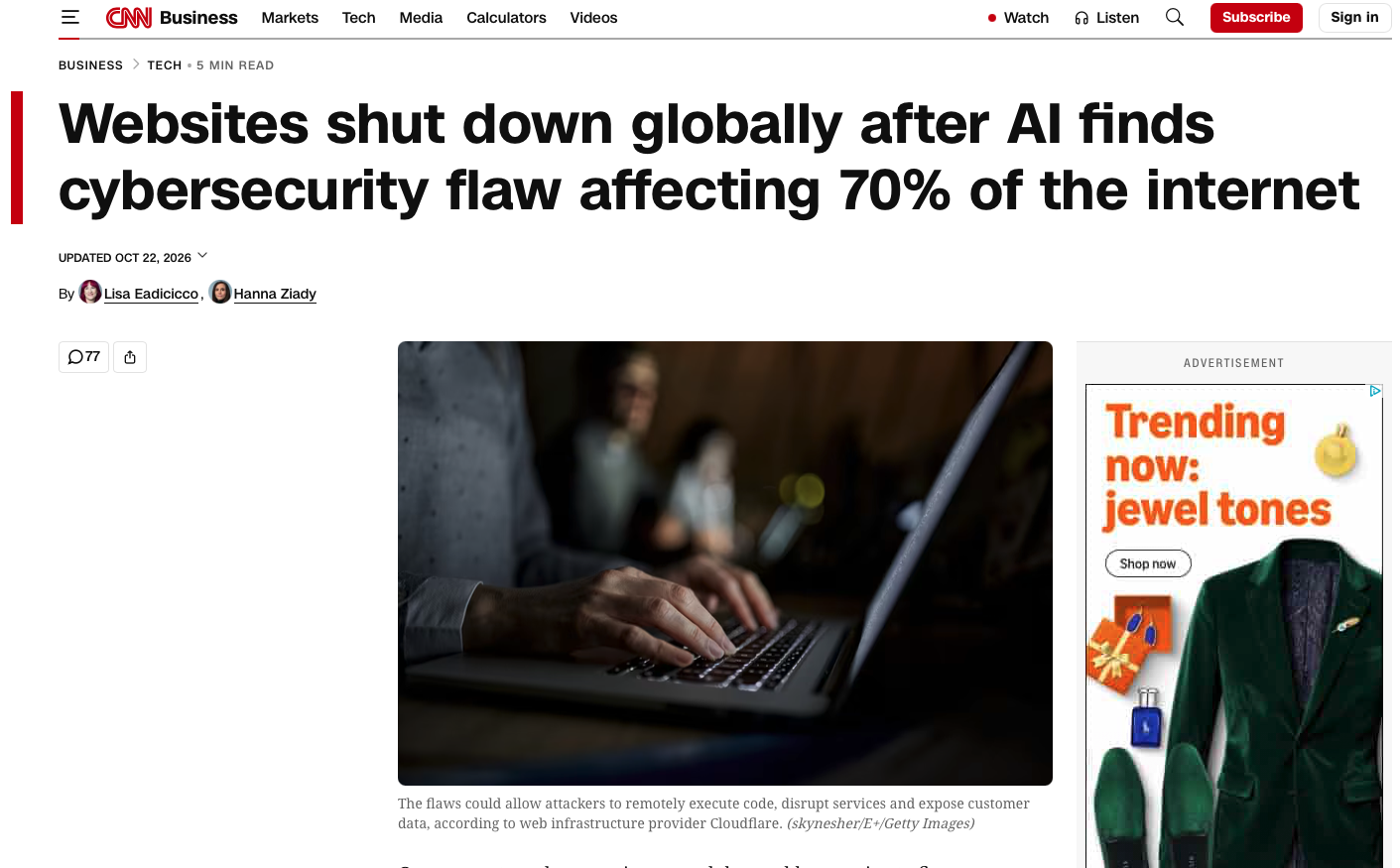
Global Outages: Governments, banks, and airlines suspended web services after AI uncovered flaws across 70% of the web. (Read the CNN Business Report, Oct 21, 2026 →)
Why Did a 22-Year-Old Bug Suddenly Become an Emergency?
As CNN’s follow-up technical analysis revealed, security researcher Stefan Esser first warned about this PHP memory behavior in July 2004. For 22 years, it went unfixed because exploiting it required forcing an out-of-memory crash at an exact microsecond—a puzzle “at the edge of what human researchers could practically achieve.”
Then researchers pointed frontier AI at the PHP codebase. The AI solved the 22-year puzzle and built a working exploit in two days.
On October 26, CISA added PHP2Shell to its Known Exploited Vulnerabilities (KEV) Catalog. Just two days later, on October 28, WordPress released emergency patch 7.1.4 for an unauthenticated upgrade race-condition RCE affecting every version back to 4.7. According to Wordfence and Aviatrix telemetry, automated bots began attacking 9 minutes after firewall deployment—logging 62,969 server takeover attempts in 24 hours.
Part 2: The Advisory — What “Locally Run AI” Means (And Why It Fuels a Hacking Plague)
Many executives assume big tech companies—OpenAI, Google, Anthropic, or Microsoft—will simply put safety filters on their chatbots to block hackers.
That misses the biggest shift in computing: Locally Run AI.
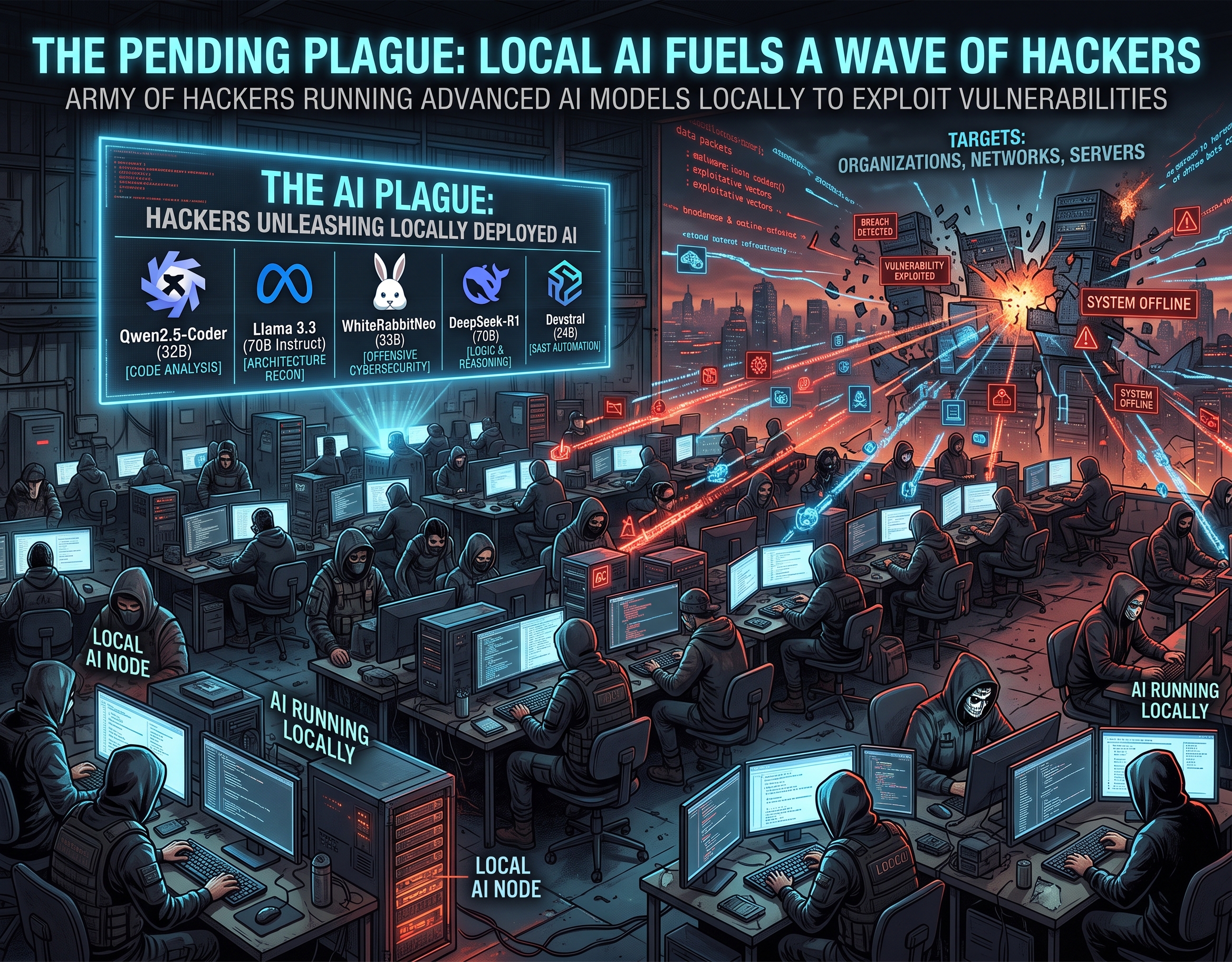
The Offline Threat Matrix: Unlike commercial cloud AI (which logs queries and blocks malicious prompts), locally hosted open-weight models run privately on consumer GPUs or hijacked servers—operating 24/7 with zero safety guardrails and zero marginal cost.
Cloud AI vs. Locally Run AI
- Commercial Cloud AI (Policed): When you use ChatGPT, Claude, or Gemini online, your request goes to a corporate data center. Ask it to write a website exploit, and the safety filter blocks the prompt and flags your account.
- Locally Run AI (Unpoliced & Unstoppable): Powerful “open-weight” AI models can now be downloaded for free and run locally on an attacker’s own hardware—a $2,000 gaming PC, a Mac Studio, or a rented server—with zero connection back to an AI company.
When an attacker runs AI locally, every guardrail disappears:
- Zero Safety Filters: Uncensored local models never refuse a command. They analyze code and write exploits on demand.
- Zero Per-Query Cost: Scanning 10,000 small-business websites costs nothing but electricity.
- Zero Audit Logs or Kill Switches: No central provider can detect the campaign or shut the account down.
- Autonomous Self-Replication: A landmark 2026 study by the University of Toronto, Vector Institute, and Cambridge proved that an adaptive worm powered by a single-GPU local LLM can read newly published 2026 CVE advisories at runtime, synthesize custom exploits on the fly, and compromise 73.8% of target machines—even hijacking victim GPUs to spawn new local AI nodes.
The Local AI Arsenal Targeting Legacy Websites
Both the Google Threat Intelligence Group (GTIG) and Sysdig Threat Research have documented attackers wiring local AI servers directly into automated hacking pipelines:
| Local AI Model Class | Primary Offensive Role | What It Does to a Legacy WordPress / CMS Site |
|---|---|---|
| Qwen2.5-Coder (32B) | Source Code Analysis | Diffs new plugin updates against old code in minutes to pinpoint the exact unpatched security flaw. |
| Llama 3.3 (70B Instruct) | Architecture Recon | Fingerprints headers, exposed /wp-json/ REST endpoints, and plugin versions to map entry points. |
| WhiteRabbitNeo (33B) | Offensive Exploit Synthesis | Converts vulnerability descriptions into live proof-of-concept payloads, webshells, and privilege escalation scripts. |
| DeepSeek-R1 (70B) | Multi-Step Reasoning | Adapts when a firewall blocks attempt #1, rewrites the payload for attempt #2, and chains bugs into full server takeover. |
| Devstral (24B) | High-Speed SAST Automation | Scans thousands of third-party plugins and themes simultaneously to uncover brand-new zero-day flaws. |
The Hard Data (2025–2026)
Per Google Threat Intelligence Group (Sept 2026) and Patchstack Security Intelligence:
- Monthly CVE Disclosures Doubled: Rose from 5,045/month (Jan 2026) to 10,740/month (Aug 2026), with High-Risk flaws surging 167%.
- 50% of AI-Discovered Bugs Are Remote Code Execution (RCE): Half of all flaws uncovered by AI allow full server takeover, vs. 26% for human discovery.
- 11,334 New WordPress Flaws Per Year: Up 42% YoY—91% live in plugins, 46% have no patch on disclosure day, and the median time from disclosure to mass automated attack is just 5 hours.
When a flaw goes public at 9:00 AM and local AI swarms are exploiting it by 2:00 PM, paying an agency to click “Update Plugins” once a month is no longer a defense.
Part 3: Live Proof From Our Threat Radar (/sitrep)
At Social Power, our security team monitors NVD, CISA, Wordfence, and Patchstack daily and publishes plain-English briefs on our WordPress Threat Situation Report (/sitrep) (see the live feed beside this article):
- PHP2Shell Runtime Memory Corruption (
CVE-2026-109618&CVE-2026-109619): CVSS 9.8 pre-application server takeover inside the PHP engine itself. - WordPress Core 7.1.4 Upgrade Race Condition RCE: CVSS 8.1 unauthenticated code execution triggered while WordPress updates itself (63,000 attacks in 24 hours).
- Rank Math Pro Supply-Chain Backdoor: Trusted SEO plugin compromised at the vendor level to inject hidden admin backdoors.
- UpdraftCentral Stolen Keys Backdoor Campaign: Backup keys weaponized to push malicious plugins to connected sites.
- SureCart & WooCommerce Unauthenticated Takeovers: Authentication bypasses and file uploads allowing unauthenticated checkout takeovers.
Every one of these compromises requires two things on your public web server: a live PHP engine and a live database.
Part 4: The Permanent Exit — Social Power Website Rescue™
Instead of selling you another firewall plugin to guard a vulnerable server, we ask a first-principles question: Why is a live computer engine and database sitting on the public internet just to show visitors your company’s pages?
When we execute a Social Power Website Rescue™, we migrate your site off WordPress and onto Social Power Static Edge Architecture. Your site is compiled ahead of time in a private, locked build environment into ready-to-serve HTML, CSS, and high-speed assets, then distributed across hundreds of global edge servers.
| Security & Operational Dimension | Legacy WordPress / Dynamic CMS | Social Power Static Edge Architecture |
|---|---|---|
| PHP2Shell & Server Runtime Exploits | Exposed. Live PHP processes parse every visitor request. | Immune. Zero PHP runtime exists on the public web server. |
| Database Breach / SQL Injection | Constant Risk. Live database sits behind public pages. | Eliminated. No public database exists to query, dump, or ransom. |
| The 40-Plugin Vulnerability Treadmill | 91% of CMS exploits. One bad plugin compromises the server. | Zero Plugins. Core features are built cleanly into the architecture. |
Brute-Force Login Attacks (/wp-admin) |
Continuous. Bots hammer /wp-login.php 24/7. |
Gone. No public login portal exists on your live domain. |
| Mobile Page Load Speed | 4 to 8 seconds (Over 60% of mobile visitors bounce). | Sub-second delivery from the global edge node nearest your customer. |
| AI Search Readiness (AOE) | Bloated plugin code obscures content from AI engines. | Includes our Agentic Optimization Engine (AOE)—semantic /ai/ Markdown vaults and schema built for Google, ChatGPT, and Perplexity. |
(Engineering note: Removing the public CMS runtime and database eliminates the vectors behind 99% of website compromises. Domain registrars, DNS, mail routing, and connected form endpoints still require proper multi-factor authentication and security hygiene, which we configure during every cutover.)
Retire Your WordPress Site in 1 to 4 Weeks (With Zero Downtime)
We engineered the Social Power Website Rescue™ to remove every headache of replacing a legacy site:
- 100% URL & Google Ranking Preservation: We inventory every existing URL, title, meta tag, and backlink before we begin so your search equity carries over intact.
- Design & Mobile Modernization: Keep the look you love or upgrade to an executive industry design—calibrated for readable typography and instant mobile tap-to-call conversion.
- Built-In AI Search Optimization (AOE): Every rescue includes a dedicated
/ai/Semantic Markdown Vault and JSON-LD Schema Graph so AI engines cite your business accurately. - Private Proofing & Pre-Staged Mail Cutover: Review your new site on a private staging link while your current site stays live. We pre-stage all email DNS (
MX,SPF,DKIM,DMARC) so you never miss a single email or call.
Retiring your WordPress website is no longer a someday marketing project—it is an immediate operational security decision.
Use the form right below to request your Website Rescue Assessment, or visit our Website Upgrade & Modernization page for full specifications.