
Industrial distribution has reached a critical inflection point. As explored in our companion analysis on B2B Catalog AI Procurement Blindness, the traditional methods of presenting products—monolithic dynamic databases, slow faceted filters, and static PDF line cards—are failing to capture modern commercial buyers and automated procurement bots.
To capture high-value enterprise purchase orders today, industrial distributors require an entirely different architectural paradigm: the Agentic Optimization Engine (AOE).
By pairing ultra-fast static edge rendering with machine-readable semantic data vaults, distributors can make their entire 10,000 to 50,000+ SKU inventory instantly searchable by human engineers and autonomously discoverable by AI procurement agents.
First Principles: The Decoupled Industrial Edge Architecture
Traditional B2B ecommerce sites execute heavy database queries every time a buyer clicks a category, calculates inventory, or filters by diameter and thread pitch. Under peak traffic, this creates high server latency, database lockups, and frequent timeouts.
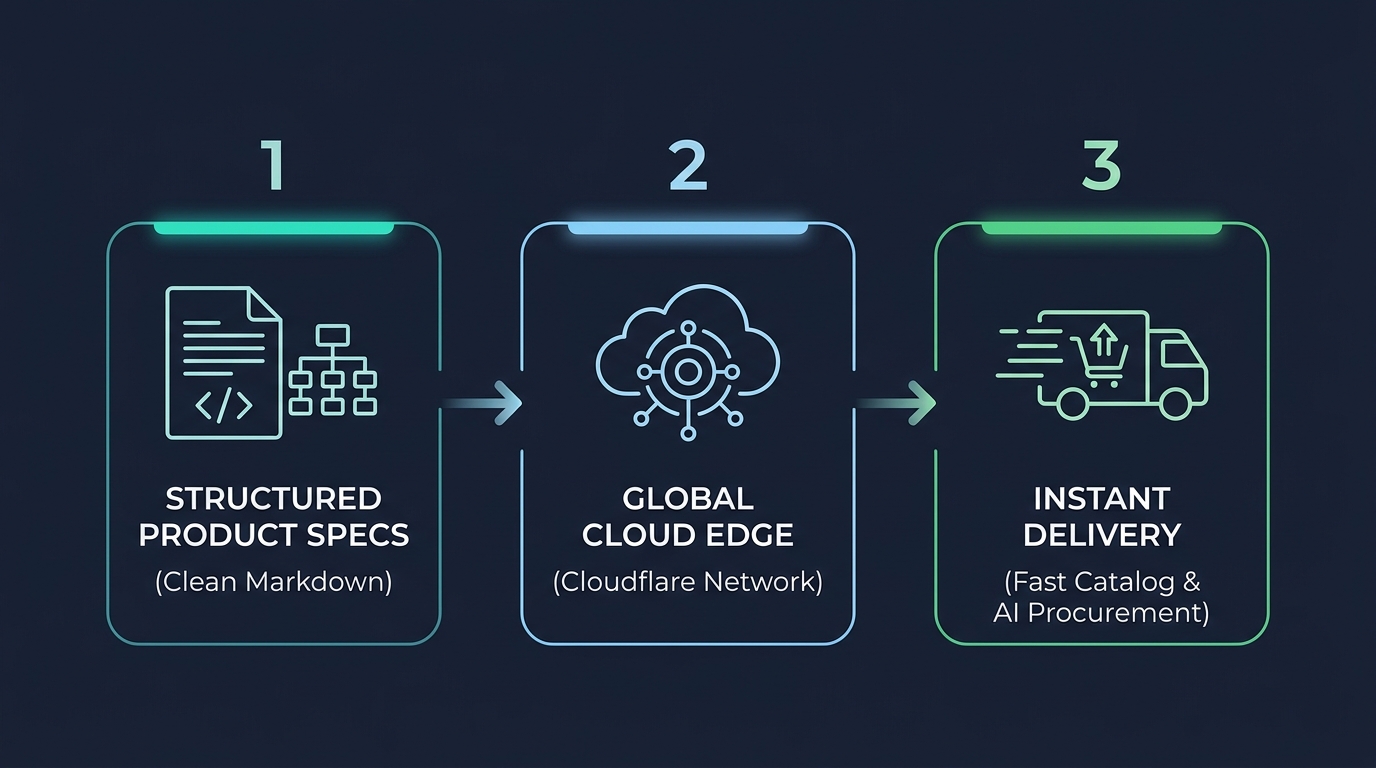
Modern pre-rendered edge architecture flips this model entirely:
| Architecture Layer | Core Capabilities & Payload | Performance & Readability |
|---|---|---|
| Human Buyer Experience | Sub-second static catalog rendering, instant dimensional and grade filters, 1-click technical drawing downloads, direct sales RFQ dispatch. | Sub-300ms page load across 300+ global edge nodes. |
| AI Procurement Agent Vault | Root /llms.txt discovery manifest, clean /ai/products/ semantic markdown vaults, structured ASTM/ISO specification tables. |
100% parseable raw data with zero JavaScript or DOM bloat. |
| Global Edge Cloud | Distributed global edge network with real-time IndexNow push syndication, automated SSL, and zero server-side database maintenance. | Zero single point of failure with 99.99% edge availability. |
Rather than rendering pages on the fly from a fragile SQL database, the entire digital catalog is pre-compiled into immutable, lightning-fast static assets distributed across hundreds of global edge data centers.
Human buyers experience sub-300ms page loads, while AI procurement crawlers are served clean, raw semantic markdown without code bloat.
The 5 Pillars of the Agentic Optimization Engine (AOE)
A production-grade AOE deployment for an industrial distributor consists of five integrated architectural layers:
1. The Root llms.txt and llms-full.txt Manifests
Located at the root of your domain (e.g., distributor.com/llms.txt), this standardized file serves as a machine-readable directory for LLMs. It explicitly defines your organization’s core stocking categories, material grades (e.g., Grade 5, Grade 8, 304/316 Stainless, B7 Heavy Hex), regional delivery radius, and direct links to full technical documentation.
2. The Semantic Markdown Vault (/ai/products/)
Traditional web pages surround product data with megabytes of navigation scripts, CSS styling, analytics trackers, and advertising pixels.
An AOE deploys a parallel, clean /ai/products/ directory containing pure Markdown files. Each file maps a distinct product line with precise technical attributes:
- Dimensional standards (ANSI, ASME, DIN, ISO)
- Hardness, yield strength, and tensile specifications
- Available finishes (Zinc, Hot-Dip Galvanized, Black Oxide, Cadmium)
- Direct 1-click RFQ endpoints
When an AI procurement agent visits, it consumes pure data with zero parsing errors and zero token waste.
3. Structured B2B JSON-LD Schema Graphs
We embed rich Product, OfferCatalog, and Organization JSON-LD schemas directly into every catalog page. This binds your manufacturer part numbers (MPNs), brand affiliations, and physical warehouse coordinates into Google’s Knowledge Graph and Bing’s enterprise index.
4. Real-Time IndexNow Push Protocol
When you add a new product line, expand a fastener grade, or publish updated technical drawings, you cannot afford to wait weeks for search engine bots to re-crawl your site.
The AOE integrates the IndexNow protocol, instantly broadcasting catalog changes to Microsoft Bing, Yandex, and integrated AI search engines the second updates are deployed.
5. Decoupled 1-Click RFQ & Technical Sales Routing
Industrial buyers do not want to add items to a retail shopping cart. They want to submit a line-item bill of materials (BOM), attach technical drawings, and receive pricing from a seasoned sales rep.
Our architecture features decoupled, serverless RFQ pipelines with end-to-end encryption that dispatch inquiries directly into your internal sales queue or ERP inbox without touching a vulnerable web database.
Architectural Comparison: Legacy CMS vs. Agentic Optimization Engine
| Architectural Dimension | Legacy Dynamic CMS (WordPress / Magento) | Agentic Optimization Engine (AOE) |
|---|---|---|
| Page Speed (TTFB) | 1,200ms – 3,500ms (server load dependent) | 150ms – 300ms (global edge cache) |
| AI Agent Readability | Poor (blocked by scripts & complex DOM) | 100% Native (pure semantic markdown vaults) |
| Catalog Scalability | Slows down as SKU count exceeds 10,000 | Effortlessly scales to 50,000+ SKUs with zero lag |
| Database Vulnerabilities | SQL injection, plugin exploits, server downtime | Zero attack surface (no dynamic web database) |
| Search Indexing Speed | Passive crawling (days to weeks) | Instant real-time push via IndexNow |
| Maintenance Burden | Constant core/plugin patching and security monitoring | Zero maintenance; immutable pre-compiled builds |
The Next Step: Auditing Your Catalog Infrastructure
If your distribution business relies on legacy software or outdated catalog pages, you are leaving your highest-margin commercial contracts open to faster, AI-enabled competitors.
Upgrading to an Agentic Optimization Engine does not require disrupting your daily warehouse operations. The deployment is clean, decoupled, and immediately effective.
Modernize Your Industrial Distribution Platform
Social Power builds high-performance digital infrastructure and Agentic Optimization Engines engineered specifically for B2B distributors and suppliers. Contact us to receive a technical blueprint for your catalog.